GED Mathematical Reasoning: What Topics Are Actually on the Test?
GoTutorGo · September 30, 2026 · 5 min read
When people tell me math is their biggest fear on the GED, I get it. The section sounds intimidating before you even open a study guide. But a lot of that anxiety comes from not knowing what's coming — and that's completely fixable. Once you see the actual list of topics, math stops feeling like a wall and starts feeling like a checklist.
So let's go through it. Here is everything that shows up on the GED Mathematical Reasoning section, explained in plain English.
The Big Picture First
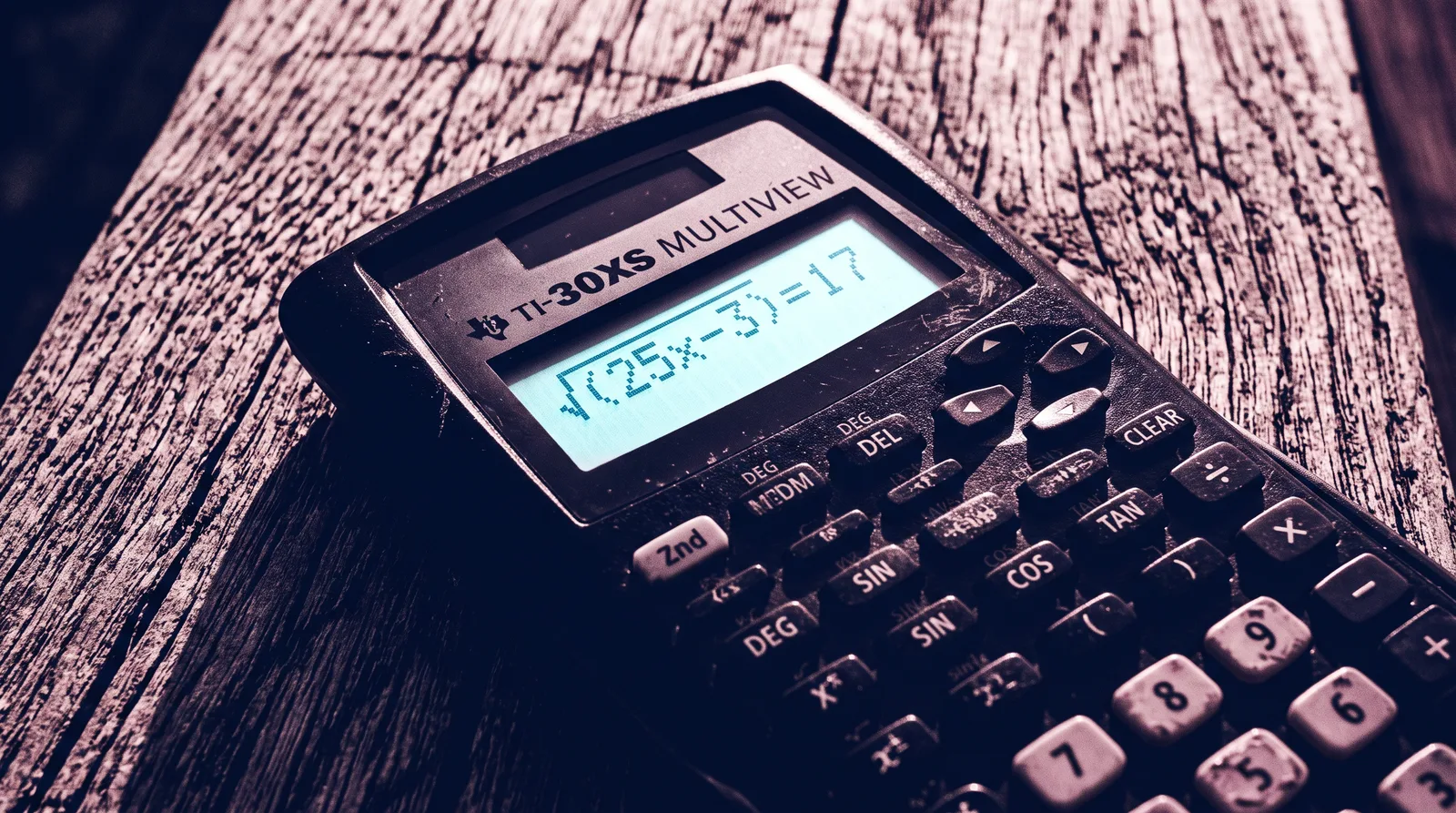
The GED Mathematical Reasoning test is 115 minutes long. It has two parts: a short section where you cannot use a calculator, and a longer section where you can (the TI-30XS is the approved calculator, and it's available on-screen during the test). Questions are a mix of multiple choice, fill-in-the-blank, drag-and-drop, and a few that ask you to plot points or select areas on a graph.
The content breaks down into two broad categories: Quantitative Problem Solving (roughly 45% of the test) and Algebraic Problem Solving (roughly 55%). Let's unpack both.
Quantitative Problem Solving
This is the "numbers and operations" side of the test — the kind of math that shows up in everyday life.
Basic Number Operations Whole numbers, integers, fractions, decimals, and percentages. You need to add, subtract, multiply, and divide all of them — including negative numbers. If you've ever calculated a tip or figured out how much something costs after a 20% discount, you've already used this math.
Ratios and Proportions If a car travels 60 miles in 1 hour, how far does it travel in 3.5 hours? That's a proportion. These show up in word problems, unit rates, and scale problems.
Percentages Percent increase, percent decrease, finding a percentage of a number, finding what percent one number is of another. These are everywhere on the test.
Statistics and Data Expect questions that ask you to read bar graphs, line graphs, dot plots, histograms, and box plots. You'll also need to find the mean (average), median (middle value), and mode (most frequent value) — and know the difference between them.
Geometry Basics Area, perimeter, volume, and surface area of shapes like rectangles, triangles, circles, and cylinders. The test gives you a formula sheet, so you don't have to memorize every formula — but you do need to know how to use them.
The Pythagorean Theorem If you know two sides of a right triangle, you can find the third. The formula is a² + b² = c², where c is the longest side (the hypotenuse). The test uses this regularly.
Algebraic Problem Solving
This is the section that makes most beginners nervous, but the concepts are more manageable than they look.
Variables and Expressions Understanding what a variable represents and how to simplify or evaluate an expression. For example: if x = 4, what is 3x + 2? (It's 14.)
Linear Equations and Inequalities Solving for x in one-step and multi-step equations. Also solving inequalities (like 2x + 3 > 11) and knowing how to graph them on a number line.
Linear Equations in Two Variables This means understanding the equation y = mx + b — slope-intercept form. You need to know what slope means, how to find it, and how to read or draw a line on a coordinate plane.
Systems of Equations Two equations, two unknowns. You'll be asked to find the values of x and y that make both equations true. The test usually approaches this through substitution or looking at graphs.
Polynomial Expressions Adding, subtracting, and multiplying polynomials. Don't let the vocabulary scare you — a polynomial is just an expression like 3x² + 2x − 5. You'll also need to factor simple quadratics.
Rational Expressions and Equations These involve fractions that have variables in them. The operations are similar to regular fractions — you still need a common denominator to add them.
Functions A function is a rule: you put a number in, you get a number out. The test asks you to evaluate functions (find f(3) when f(x) = 2x + 1), identify whether a relationship is a function, and sometimes interpret a graph of a function.
Quadratic Equations Solving equations where x is squared, like x² − 5x + 6 = 0. You can solve these by factoring or by using the quadratic formula — both of which appear on the formula sheet the test provides.
One More Thing About That Formula Sheet
The GED gives you a reference sheet during the test. It includes formulas for area, volume, the Pythagorean theorem, the quadratic formula, and slope. This is genuinely useful — but only if you've practiced applying those formulas ahead of time. Seeing a formula you've never worked with during a timed test isn't helpful. Practice is what makes the formula sheet a tool instead of a distraction.
Your Next Move
Now you have a real map. Instead of studying "math," you can study specific topics — and check them off one by one. Some of these you may already know better than you think. Others will take a few focused sessions to click.
In my GED Ready Academy, we move through each of these topics in structured lessons with practice problems built in — so you always know where you are and what comes next. But even with this list alone, you can open any GED prep book or free resource and immediately find exactly what you need to work on.
That's the goal: clarity before confidence, and confidence before test day.